How to Trade Meme Coins With a Tiny Portfolio Without Fees Eating Your Edge
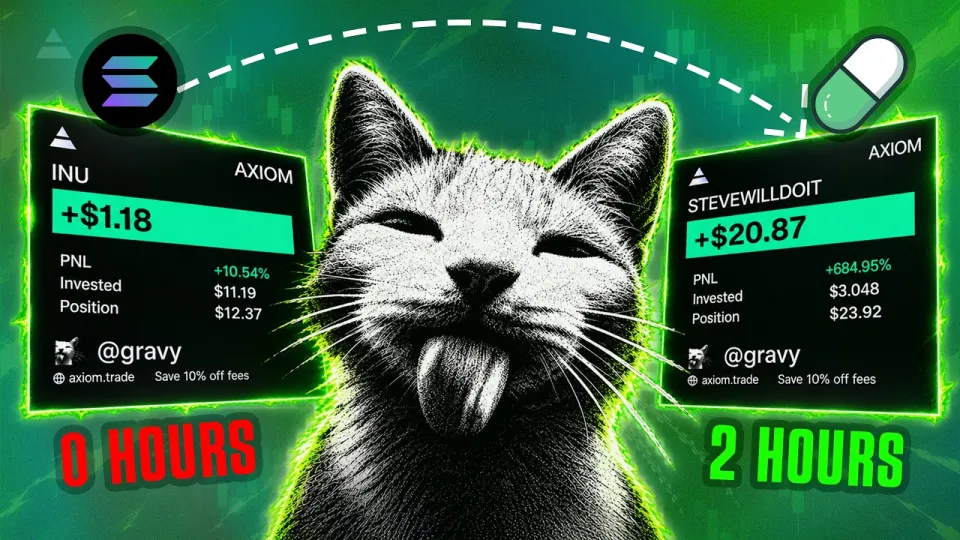
Video: I Tried Trading Memecoins with Just $10
Need articles like this for your video? They help promote it on YouTube and Google — order them in the Telegram bot @sat_sit_bot. The bot writes and publishes the articles itself (with your YouTube video embedded) on popular topical websites (no ads). Try it free: 50 articles on us.
Key takeaways
- Five real trades, each buy kept under 0.05 SOL — roughly $10 at SOL prices near $200.
- Platform used: Axiom on Solana, with referral cashback and reduced fees.
- Coins traded: STEVEWILLDOIT, NPC, MET (Meteora), PUMPY the Trader, UNTXD.
- The X Money meta ran on e/acc and Cream narratives, not on fundamentals.
- One trade was badly fumbled — the experiment is about process, not a single win.
You can trade meme coins with a tiny portfolio, but only if position size, fees and exit rules are decided before you click buy. The practical recipe is to cap each buy at a fraction of your bankroll (in the gravy experiment, every entry stayed under 0.05 SOL), trade only liquid Solana pairs, and treat every coin as a lottery ticket with a pre-set invalidation point. The experiment was run through Axiom's trading terminal, which is where the referral cashback and fee discount apply.
What a $10 meme coin experiment actually tests
A small bankroll does not test your ability to pick winners; it tests whether your process survives friction. Five trades were executed, each with a buy under 0.05 SOL, and the point was to document the reasoning behind every entry and exit rather than chase a single moonshot.
At SOL prices in the low hundreds of dollars, 0.05 SOL is roughly $10 — meaning a single trade is the whole bankroll. That forces a different discipline than a $1,000 account:
- One position at a time, so a rug cannot wipe the account in a single candle.
- Fixed maximum loss per trade, defined before entry.
- No averaging down into a coin that already broke its thesis.
- Small realized profits taken into strength, because fees and slippage are a larger share of a tiny position.
The honest limitation: with $10, even a 3x is $20 of profit. The real output of such an experiment is a repeatable checklist, not income.
The five trades and what each one was really about
The trades were STEVEWILLDOIT, NPC, MET (Meteora), PUMPY the Trader and UNTXD — each chosen for a narrative rather than a chart pattern. Meme coin trading on Solana is narrative trading: you are buying attention and the probability that more people arrive after you.
- STEVEWILLDOIT — a personality-driven meme built on a "yes, I'll do it" bit, the kind of coin that lives or dies on whether the joke keeps spreading.
- NPC — a meta coin riding the ironic "NPC" internet archetype, where the ticker itself is the marketing.
- MET (Meteora) — a trade tied to an ecosystem name rather than a pure joke, which changes the holder base and the exit liquidity.
- PUMPY the Trader — a character coin aimed at the trading crowd itself, so its audience overlaps with the people buying it.
- UNTXD — a lower-attention play where the risk of thin liquidity is materially higher.
One of the five was fumbled badly, which is the most useful part of the exercise: the loss came from execution and timing, not from the coin being uniquely evil.
Why the X Money meta ran and how to read a narrative cycle
The X Money coin meta was driven by the e/acc and Cream crowd — a cluster of accounts with a shared ideology and a habit of amplifying each other. That is the actual engine of most short-lived meme rotations: not a product, not revenue, but a coordinated group with a reason to post.
A practical way to read any narrative cycle:
- Identify the in-group. Who is posting about it, and do those accounts already have a track record of pumping the same kind of coin?
- Check the timeline of the joke. If the phrase has been circulating for days with no new angle, you are late.
- Look for the second wave. The safest small-portfolio entry is usually the moment a narrative jumps from its original niche to a broader feed.
- Watch liquidity, not market cap. A $2M cap with $40k of liquidity is a trap for a small buyer; slippage alone can erase the edge.
- Accept that you will sell early. Selling a runner at 40% of its move is normal and correct for a $10 account.
Fees, slippage and the referral mechanics on Solana
Fees are not the main killer of small meme coin accounts — bad exits and slippage are, but fees still matter at this size. On Solana, a swap costs a network fee plus a platform fee, and priority fees rise when the chain is busy; on a 0.05 SOL buy, a few cents of friction is a meaningful percentage.
That is the logic behind trading through a referral link: the Axiom signup gives 2x cashback and 15% lower fees, which compounds across dozens of small trades. Practical rules for keeping friction low:
- Batch your decisions. Ten impulsive 0.01 SOL trades cost more in total fees than two deliberate 0.05 SOL trades.
- Avoid entering during congestion spikes, when priority fees and failed transactions pile up.
- Never market-buy a coin with liquidity so thin that your own order moves the price several percent.
- Track net profit after fees, not the green number on the position.
The real problem: finding narratives without drowning in Twitter
The most common failure for beginners is not picking bad coins — it is information overload and late entries. Scrolling every tweet, trying to remember who has influence, and then buying a dip that never recovers is a structural problem, not a skill problem.
A workable filter for a small account:
- Follow a short list of accounts that consistently surface coins before they trend, and mute everything else.
- Write the thesis in one sentence before buying. If you cannot, you do not have a thesis.
- Define the invalidation level at entry — the price or time limit at which the idea is dead.
- Take partial profit on the first strong impulse, because meme coins rarely give a second clean exit.
- Review each trade after the fact and label it: process error, thesis error, or bad luck.
The pattern where you sell at a 20–40% loss and then watch the coin run higher is usually a sizing and time-horizon mismatch: the position was too large to hold through normal volatility.
Common questions from small-portfolio traders
Most doubts around low-balance meme coin trading repeat themselves: whether it is possible at all, how to find coins with good narratives, and whether live trading with a public wallet is worth it. The consistent answer is that the bankroll size is not the constraint — the constraint is having a written rule for entry, exit and maximum loss, and following it for at least twenty trades before judging results.
A live session starting from 0.1 SOL, which the channel floated as a follow-up, is a useful test precisely because it removes the option to hide behind hindsight. Watching a doxxed wallet take real entries and real losses shows the decision process, which is what a beginner actually needs to copy.
Useful links
- Axiom trading terminal with referral cashback: https://axiom.trade/@gravy
- The Trenches Discord: https://discord.gg/W7TqkExcSd
- Discord with free Axiom imports and trade signals (NFA): https://discord.gg/9W5j3XUgYB
- Author on X: https://x.com/gravyski
- Leverage trading with 20% futures fee reduction: https://www.bitbase.com/landing-page/trading-earning-Gra?ref=8CYOGY
Bottom line
Trading meme coins with a $10-style bankroll is possible, but it is a training exercise in process, not a path to meaningful income. The five-trade run on gravy's channel shows the realistic shape of it: sub-0.05 SOL entries, narrative-driven picks like STEVEWILLDOIT and NPC, one badly fumbled trade, and fees that only stay manageable with deliberate sizing. Copy the checklist — one position at a time, a written thesis, a defined invalidation point, partial profits into strength — before you copy any ticker. If you want the same fee and cashback setup used in the experiment, start through Axiom via the referral link and keep your first month's size small.
Source: I Tried Trading Memecoins with Just $10 · Markdown version
Questions & answers
Can you really trade meme coins with only $10?
Yes, technically — a 0.05 SOL buy is roughly $10 at recent SOL prices, and five such trades were executed successfully on Solana. The catch is that fees, slippage and priority fees take a larger percentage of a tiny position, so profits are small even on a good call. Treat it as practice for process, not as an income strategy.
How do I find meme coins with good narratives before they run?
Narrow your feed to a short list of accounts that consistently surface coins early, and check whether a narrative is moving from a niche group into the broader timeline. Write the thesis in one sentence and set an invalidation level before buying. If the joke or meta has already been circulating for days without a new angle, you are probably late.
Why do I lose 20–40% and then watch the coin recover after I sell?
That usually means the position was too large for your risk tolerance or the time horizon was undefined, so normal volatility forced you out. Define a maximum loss and a time limit at entry, and size the trade so a standard pullback does not trigger panic. Partial profit-taking on the first strong move also removes the pressure to make one perfect exit.
Is it worth trading through a referral link on Axiom?
A referral signup gives 2x cashback and 15% lower fees, which matters more the smaller your average trade is. Over dozens of sub-0.05 SOL entries, that discount is real money relative to the bankroll. Just remember that lower fees do not fix bad entries — the checklist still does most of the work.